Health and Safety Policy for House Clearance Mayfair
 This Health and Safety Policy sets out the responsibilities and working standards for our house clearance operations. It applies to all staff, contractors and subcontractors involved in house clearance, rubbish removal and associated salvage or disposal activities. The intent of the policy is to protect the health and safety of employees, clients, members of the public and any third parties while delivering professional house clearance services and rubbish collection in our service area. The policy establishes clear expectations for safe working, hazard control and compliance with relevant statutory duties.
The policy is designed to be pragmatic and proportionate for a rubbish company operating in residential and commercial environments. It complements but does not duplicate local statutory guidance. All personnel engaged in Mayfair house clearance and related removal work must be familiar with this policy and any site-specific risk assessments. Managers must ensure that this policy is implemented and reviewed regularly to reflect changes in working methods, equipment or regulatory requirements.
 Scope: This statement covers routine domestic clearances, office and light commercial clear-outs, bulky item removal and the handling, storage and transport of waste and recyclable materials. It does not provide operational guides but defines responsibilities, reporting procedures and control measures to manage common hazards encountered by a house clearance company. Emphasis is placed on preventing injury from manual handling, vehicle operations, sharps, hazardous goods and slips, trips and falls.
Responsibilities and Management
Managers and supervisors are responsible for implementing the policy and ensuring team members can demonstrate safe working practices. Employees must work safely, report hazards and use issued personal protective equipment. Contractors must follow the same safety rules when undertaking any rubbish removal, clearance or transport tasks. The company will ensure all operatives receive appropriate induction training and access to ongoing competency checks.Risk Assessment and Control Measures
All clearance projects require a documented risk assessment before work starts. Risk assessments will identify significant hazards and set out control measures such as segregation of waste streams, use of mechanical aids, PPE requirements and traffic management. Controls will be proportionate to the activity and may include the following:- Manual Handling Controls: use of trolleys, lifting straps and team lifting where appropriate;
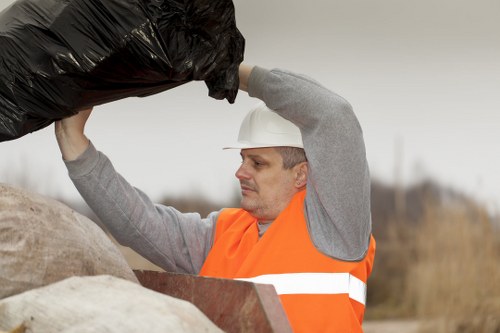
- PPE: gloves, eye protection, hi‑vis clothing and safety boots for all clearance staff;
- Site Controls: cordoning off drop zones, slip prevention and safe access routes.
 Training and competence are key. All operatives will undertake induction training that covers manual handling, safe lifting techniques, correct use of PPE and basic hazardous materials awareness. Specialists handling asbestos-containing materials, solvents or electrical waste will be certified and operate under additional procedures. Supervisors will carry out spot checks to confirm competence during live clearances.
Equipment and vehicle safety require routine maintenance and inspection. Vehicles used for rubbish collection and house clearance must be roadworthy, securely loaded and operated in accordance with weight limits and safe loading practices. Drivers and loaders have responsibilities to ensure loads are contained, signage is used when required and that appropriate restraints are fitted to avoid shifting during transit.
Manual handling remains a primary cause of injury in clearance operations. Work methods will prioritise mechanical aids over manual lifting where possible. Where manual handling cannot be avoided, tasks will be risk assessed for weight, frequency and awkward postures. A combination of ergonomic practice, team coordination and planned task rotation reduces the risk of musculoskeletal injury.
Hazardous materials must be identified and segregated. Items such as solvents, batteries, fluorescent tubes, paints and electrical equipment should be managed in line with accepted waste classification and containment practices. If identified during a domestic or commercial clearance, hazardous items will be isolated and only handled by trained staff with suitable PPE and containment. The company will make reasonable efforts to ensure safe storage prior to transfer to authorised disposal facilities.
Accident reporting and incident investigation are integral to continuous improvement. All accidents, near misses and dangerous occurrences must be reported promptly. Investigations will seek to identify root causes and implement corrective actions, which may include additional training, procedural changes or equipment upgrades. The goal is to reduce recurrence and maintain a safe working environment for our house clearance teams and clients.
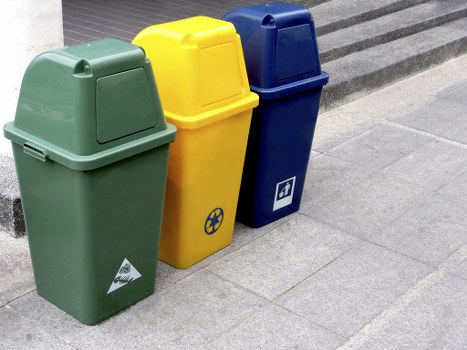
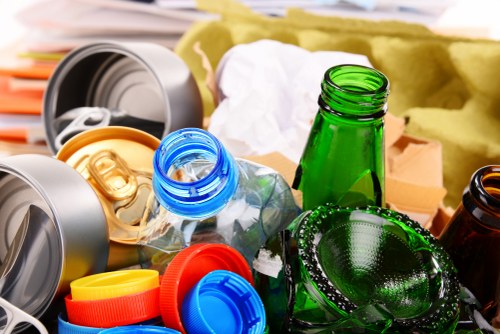
 Environmental and waste segregation practices form part of our safety commitments. Proper sorting of recyclables, electronic waste and general rubbish reduces contamination risks and supports responsible disposal. Employees are instructed to separate recyclables at source and use designated containers to minimise handling and cross-contamination during transfer and transport.
 Policy review and compliance: This Health and Safety Policy will be reviewed periodically and updated to reflect operational changes and lessons learned from incident reports. Compliance will be monitored through site audits, toolbox talks and management reviews. Non-compliance with this policy may result in disciplinary action where appropriate, and the company will take reasonable steps to enforce safe practices across all house clearance and rubbish removal activities.
Summary of key commitments:
- Protect people: prevent injury through risk assessment and controls;
- Train and supervise: ensure competence for clearance and rubbish collection tasks;
- Manage waste safely: segregate hazardous items and maintain secure transport;
- Review and improve: investigate incidents and update procedures.
End of policy statement.